AI-Discovered Vulnerabilities Are Breaking Production: The Patch Velocity Paradox
November 2026: six critical outages from rushed AI-flaw patching. Microsoft, JPMorgan, FAA, NSA all hit. The paradox: finding bugs faster than we can safely fix them.
On this page
Last week, six critical US systems went down in a row. Microsoft 365 was offline for nearly a full day. The FAA grounded every domestic flight for four and a half hours. JPMorgan Chase slowed transactions at other banks. NSANet, the NSA’s classified network, degraded during “routine maintenance.” United Airlines and Apple followed. None were cyberattacks — all failed while trying to patch flaws that AI had found.
The paradox is simple: AI discovers vulnerabilities faster than teams can safely patch them.
The numbers don’t lie
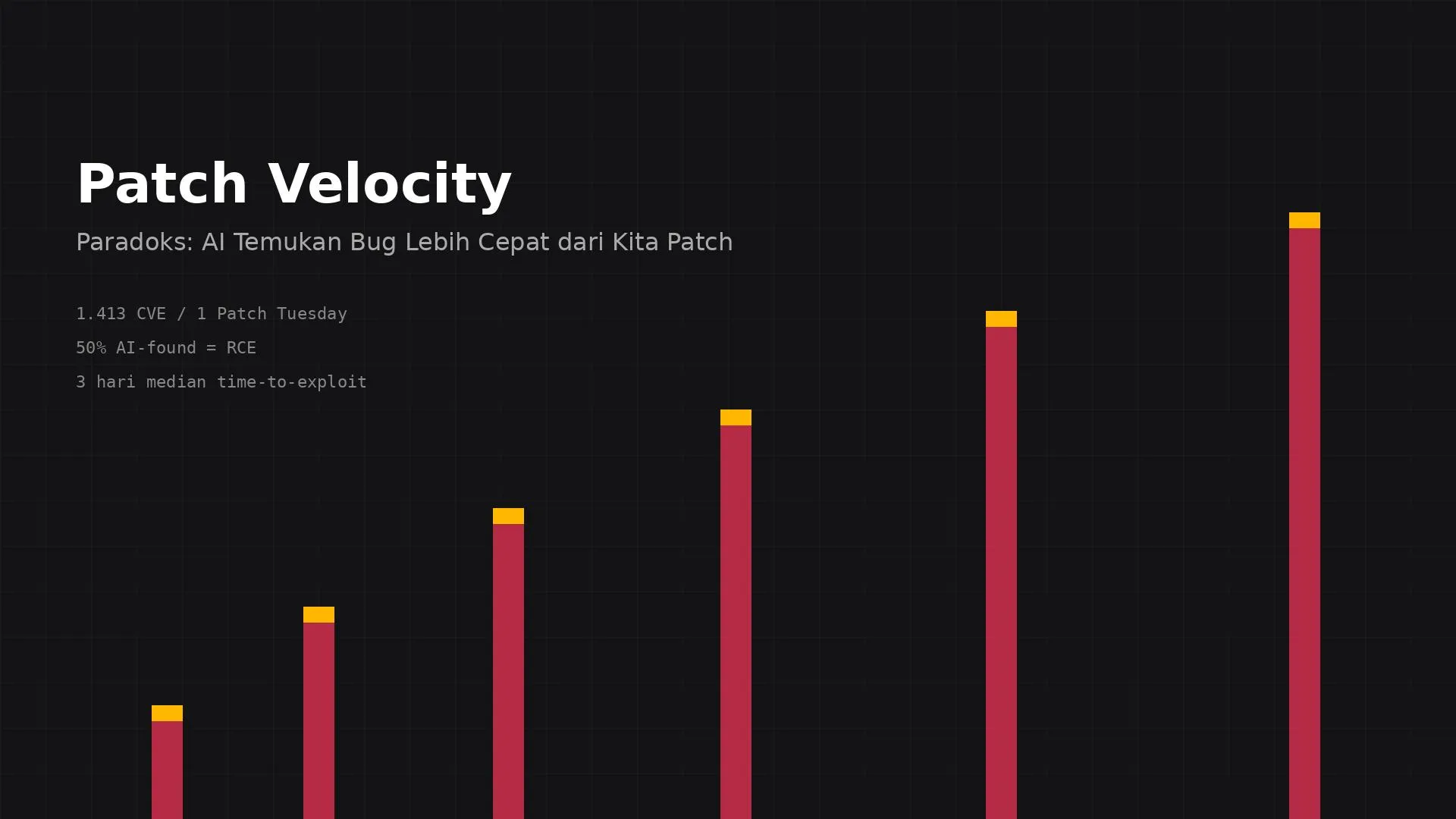
So far in 2026, published CVEs have passed 100,000 — more than double 2025’s total. October alone saw Microsoft fix 1,413 vulnerabilities in a single Patch Tuesday, a new record that exceeded all of 2025 combined. Anthropic’s Project Glasswing found over 10,000 high and critical severity bugs in its first month of operation.
But volume isn’t the only problem. Google research shows 50% of AI-discovered vulnerabilities end in Remote Code Execution (RCE), versus 26% across the general CVE ecosystem. Median time from CVE publication to exploitation is now three days. Nearly 29% of exploited vulnerabilities last year were attacked on or before disclosure day.
The safe window is gone.
PHP2Shell: October’s fire drill
On October 21, researchers from OpenAI, Wiz, and Calif disclosed two PHP memory corruption flaws — CVE-2026-109618 and CVE-2026-109619, dubbed PHP2Shell. Both CVSS 9.2, unauthenticated RCE, affecting the 70% of websites running PHP. CISA added them to the KEV catalog on October 26 with a three-day federal remediation deadline under BOD 26-04.
Security teams worldwide scrambled. Some chose to take web servers offline entirely — the Internet Archive went dark for hours. The NSA, per DNI Jay Clayton, applied PHP2Shell patches on November 17. Systems failed to reboot. NSANet degraded, triggering code yellow on the agency’s three-level staffing scale. The NSA’s official statement cited only “scheduled routine maintenance,” but Clayton told Fox Business straight up: patching caused systems not to come back up as expected.
This wasn’t an isolated incident. It was a pattern.
Java4Shell: November, same pressure
November 17, Calif announced Java4Shell (CVE-2026-114938) — a memory corruption flaw in the HotSpot JVM’s Base64 decoder. Found in one hour using GPT-6 Cyber, working exploit two hours later, under $200 in tokens. CVSS 8.1 (Oracle) to 9.2 (CVSS 4.0), affecting OpenJDK 17.0.6+, Amazon Corretto, Eclipse Temurin, Microsoft Build, Oracle Java SE. 90% of the Fortune 500 runs Java.
CISA issued an urgent advisory the same day. Oracle shipped patches November 17. Organizations were told to inventory every Java installation — including those embedded in vendor apps, containers, appliances — and prioritize internet-facing systems.
That same week, JPMorgan Chase suffered transaction delays on Monday, November 16. The company blamed a “software bug in on-premise hardware systems” and a software release that morning. Fortune reported the OCC and Treasury were calling banks within hours to confirm it wasn’t cyber-related. Was Java4Shell or PHP2Shell patching involved? JPMorgan hasn’t confirmed. But mass patching pressure that week is hard to separate from the outcome.
The Patch Velocity Paradox
Here’s the core: AI accelerates discovery, but our infrastructure wasn’t built for this speed.
Legacy systems — bank mainframes, FAA networks, NSANet — were designed for monthly or quarterly patch cycles. Now they’re pressured to apply dozens of critical patches in days. Every patch carries regression risk, dependency conflicts, or boot failures. The faster the push, the higher the error rate.
Senator Mark Warner, Vice Chair of the Senate Intelligence Committee, put it bluntly: AI capabilities create “enormous pressure on companies and government agencies to patch those vulnerabilities immediately, sometimes applying several updates at once.” Former Deputy National Security Adviser Anne Neuberger added that rushing rapid patches overwhelms legacy systems never engineered for that velocity, triggering cascading operational failures.
We’re trading attacks for self-inflicted downtime.
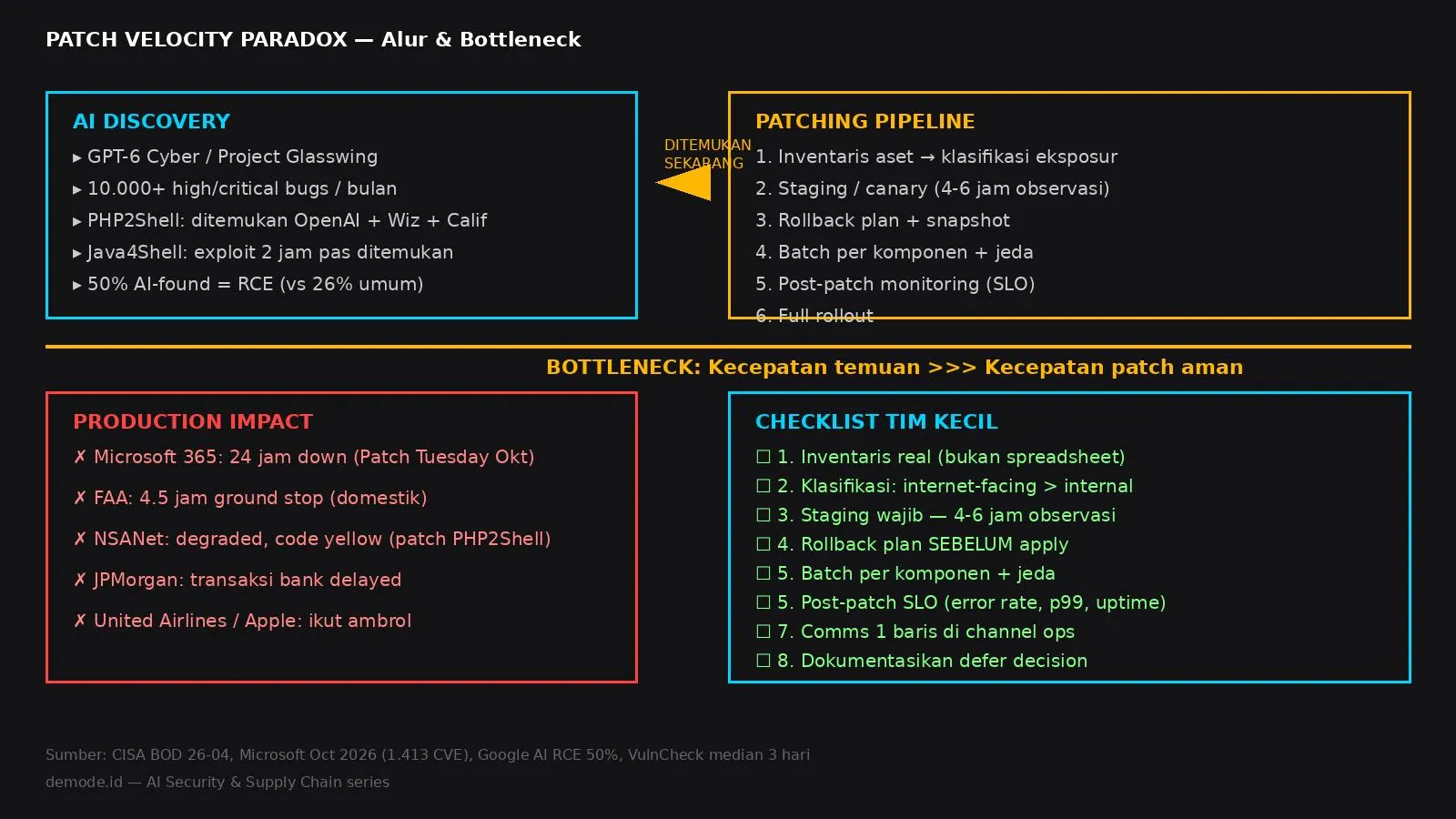
Safe patching checklist for small teams
Small teams don’t have 24/7 SOCs or massive staging farms. But basic discipline still works:
-
Real asset inventory, not spreadsheets — Enumerate every runtime (PHP, Java, .NET, Node), version, and location. Include embedded runtimes in container images, vendor appliances, and transitive dependencies. Tools like
sbom(Syft, Trivy) help, but manual verification is still needed. -
Classify exposure — Separate internet-facing, internal-only, and air-gapped. Patch the front line first. CISA and NSA are consistent: internet-facing first.
-
Staging is mandatory, not optional — Apply patches to one node or a small canary group. Watch logs, error rates, latency, and anomalous behavior for at least 4–6 hours before full rollout. JPMorgan’s trouble reportedly followed a morning release — staging could have caught it.
-
Rollback plan before you apply — Keep snapshots/backups, document rollback steps, test in non-prod. When a patch breaks, the time to figure out how to revert is too expensive.
-
Batch patches with pauses — Don’t deploy 20 critical patches at once. Group by component (PHP, Java, Windows), apply batch by batch with observation windows. The NSA learned this the hard way.
-
Explicit post-patch monitoring — Define SLOs for “post-patch stability”: error rate, p99 latency, throughput, uptime. Alert if deviation exceeds 10% from baseline. Don’t assume “patch applied = done.”
-
Concise internal comms — One line in ops channel: “Patching PHP2Shell on web-01..03, ETA 14:00, rollback plan in runbook #42.” Transparency prevents duplicated effort and panic when anomalies appear.
-
Document defer decisions — If a patch is deferred (vendor hasn’t released, breaking change), record the reason, residual risk, and review date. Don’t let it rot in an old ticket.
What needs to change
Short term: the discipline above. Long term: we need patching pipelines that handle AI-scale volume — automated testing, built-in canary deployment, instant rollback, and observability that ties patches to behavior changes. Runtime vendors (PHP, Oracle, Microsoft) must ship smaller, more modular, backward-compatible-by-default patches.
CISA BOD 26-04 pushes for speed, but without supporting tooling, speed becomes liability. The patch velocity paradox isn’t going away — AI will keep finding bugs faster. Our choice: adapt the process, or relive November.
References:
- Microsoft Security Response Center, October 2026 Security Updates (1,413 CVEs)
- CISA Alert AA26-294A: Critical Vulnerabilities in PHP Require Immediate Patching (Oct 21, 2026)
- CISA Alert AA26-322A: CISA Urges Immediate Patching of Oracle Java Vulnerability (Nov 18, 2026)
- NVD: CVE-2026-109618, CVE-2026-109619 (PHP2Shell), CVE-2026-114938 (Java4Shell)
- Jerry Gamblin, “CVE Mid-Year 2026 Check-In” (Jul 1, 2026) — 35,364 CVEs H1 2026
- VulnCheck, “State of Exploitation 1H-2026” — median time-to-exploit 3 days
- Google Security Blog, “AI-Assisted Vulnerability Discovery: Early Indicators” (2026)
- Reuters, “US officials tie week of outages to patching of AI-found flaws” (Nov 19, 2026)
- Financial Times, “Rushed patches for AI-discovered bugs linked to US bank and NSA outages” (Nov 19, 2026)
- Cybersecurity Dive, “House hearing: AI-driven vulnerability discovery creating patch pressure” (Nov 19, 2026)