REA: When AI Starts Disassembling Printer, TV, and Car Firmware
Reverse Engineer Anything (REA) exploded viral in November 2026. This open-source tool enables AI agents to automate firmware and binary analysis without source code. This article covers technical mechanics, supply chain implications, and the defensive posture organizations need.
On this page
- November 2026: The Week That Changed Everything
- What REA Actually Is (And Isn’t)
- Mechanics: From Firmware to Evidence Record
- Supply Chain Implications: “Assume Everything Is Readable”
- AI Lab Guardrails vs. Hardware Owner Rights
- Defensive Posture: What Organizations Must Do Now
- Back to Reality: Not Magic, Not the End of the World
- Conclusion: Ready or Not, This Era Has Arrived
November 2026: The Week That Changed Everything
First week of November 2026, the GitHub repository morluto/rea surged from tens of thousands of stars to over 400,000 in days. No enterprise product launch, no marketing campaign—just an MIT-licensed open-source tool that suddenly became the talk of reverse engineering Discord servers, Reddit’s r/ClaudeCode threads, Dragos reports, and Scientific American interviews.
Full name: Reverse Engineer Anything. Short: REA.
What happened wasn’t just GitHub star hype. REA packaged something that has long been manual, expensive, and exclusive: automation of firmware and binary analysis at scale via AI coding agents. And when that became free and packaged as an MCP server callable by Claude Code, Cursor, or Codex—access barriers collapsed.
What REA Actually Is (And Isn’t)
Let’s be honest: the name “Reverse Engineer Anything” overpromises. The reality is more mundane—and that’s exactly why it’s dangerous.
REA is:
- An MCP server and CLI (
npm install -g rea-agents) that bridges AI coding agents with existing reverse engineering tools: Ghidra, IDA Pro, Hopper, JADX, Binwalk, Unblob, TShark, sigrok-cli. - An orchestrator. REA itself doesn’t decompile. It asks the agent to call the right tool, gathers results, and packages them as Evidence Records—findings +
evidence_id+ explicit boundaries on what was not investigated. - A firmware pipeline: Binwalk 3.1.x for region scanning, Unblob 26.6.x for explicit extraction. Linux x64 only. No device, root, mount, emulation, or execution of extracted binaries required.
REA is not:
- A new decompiler. Output is pseudocode and assembly from Ghidra/IDA/Hopper—not the vendor’s original source code.
- A sandbox. Its
SECURITY.mdis blunt: “bridge sessions are not a sandbox, parsing an untrusted binary runs with your user permissions, and runtime capture executes the target.” Run suspicious targets in a VM. - A binary patcher. Ghidra annotations/renames are ephemeral in the session database; the executable bytes remain untouched.
- Fully local by default. REA doesn’t upload your binary, but decompilation output, strings, and findings go to the agent. If the agent is cloud-hosted (Claude, Codex), that data goes to the provider. Fully local requires a local-model agent setup—with a quality trade-off.
Mechanics: From Firmware to Evidence Record
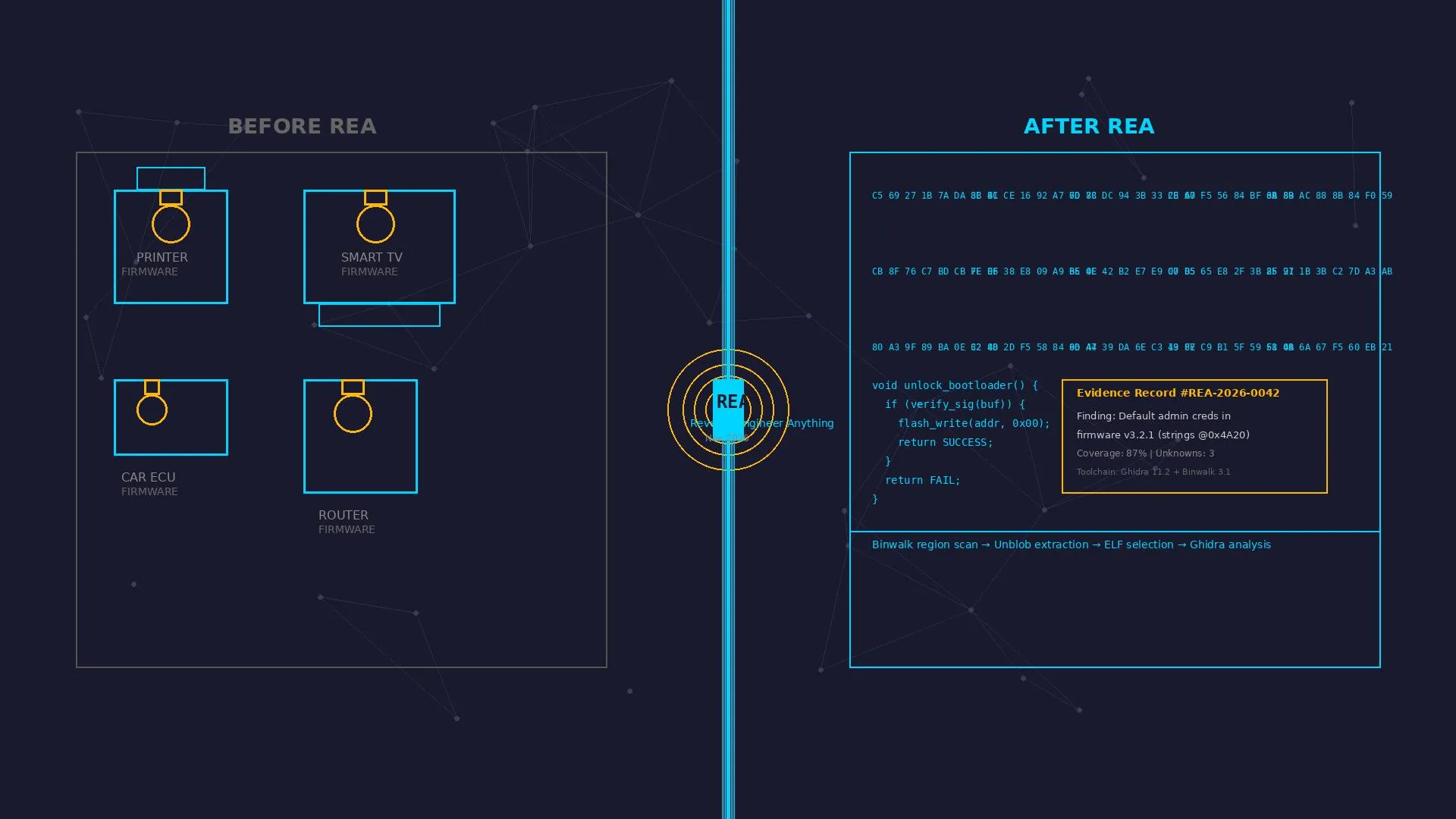
The REA firmware workflow looks like this:
Firmware binary → Binwalk (region scan) → Unblob (extraction)
  → Select relevant ELF → Ghidra/IDA/Hopper (native analysis)
  → Agent reads pseudocode, assembly, strings, symbols, xrefs
  → Returns Evidence Record: findings + coverage + unknowns
The differentiator: every finding is evidenced. The agent can’t “guess” logic—it must point to an assembly instruction, a decrypted string, or a function cross-reference. What wasn’t investigated is explicitly documented as unknown. This isn’t AI magic; it’s rigorous bookkeeping that was previously manual and prone to omission.
The community has already documented dozens of real cases:
- Sony A6000 firmware 3.21: 2-byte patch for silent electronic shutter (later bricked, recovered via SWD)
- Legacy router: admin password reset via vulnerability found by Codex + REA in ~40 minutes
- Samsung Smart TV: Apple TV gen-1 Bluetooth remote protocol reverse engineered, Linux driver written
- Xiaomi 360 Camera: chip-off firmware extraction + modification to reduce cloud dependency
Not theoretical. People are already modifying hardware they own—printers, TVs, cameras, routers—replacing vendor firmware with open-source alternatives or “vibe-coded” builds.
Supply Chain Implications: “Assume Everything Is Readable”
Dragos’ November 2026 report states it plainly: “Plan as if every device, binary and protocol you run is readable, because for all intents and purposes, it is.”
Why does the supply chain become the critical weak point?
-
One readable component → dozens of sectors exposed. A single RTOS network stack used across solar inverter families, substation relays, and industrial gateways—read once, exploited everywhere downstream.
-
Firmware shared across product families. One binary running on thousands of IoT devices, PLCs, robot controllers, medical devices. One finding = fleet-scale attack vector.
-
Minimal security teams. Energy, critical manufacturing, defense industrial base—many run on one person who also handles help desk. REA drops exploitation cost drastically: default creds, exposed services, unpatched firmware—all become “cheap at scale.”
-
Software Bill of Materials (SBOM) becomes urgent. Not a compliance checkbox. Need mapping of every remote access path and vendor connection, plus monitoring of east-west OT network traffic—not just perimeter.
Dragos exposure table (summary):
| Sector | Most Readable Targets | Most Likely Impact | Exposure |
|---|---|---|---|
| Energy | Substation IEDs, protection relays, inverter firmware, gateways | Rapid weaponization of relay/inverter flaws across entire fleets | High |
| Critical Manufacturing | PLC families, robot controllers, engineering software | Line stoppage, logic tampering, IP theft from controller code | High |
| Defense Industrial Base | Manufacturing OT, supplier firmware | Supply chain compromise & IP loss | Elevated |
AI Lab Guardrails vs. Hardware Owner Rights
The other dynamic emerging simultaneously: sudden guardrails.
The same week REA exploded, 404 Media reports and REA Discord threads noted: Claude Code and OpenAI Codex users suddenly blocked when attempting to reverse engineer devices they own—unbricking IoT, removing surveillance ads on smart TVs, swapping printer OSes.
Anthropic and OpenAI added safety checks preventing “cyber abuse” and “decompilation.” Accounts banned. Reddit r/ClaudeCode: “The Dream is dead. REA is not likely to work with Claude.”
This creates a strange dynamic: major AI labs protecting major hardware corporations when users find ways to use LLMs to bypass manufacturer-imposed restrictions on devices they already purchased.
Morluto (REA creator, pseudonymous) to Scientific American: “REA lets artificial intelligence agents pull apart programs and reconstitute them to their users’ liking.” Community Discord is full of examples: printers, TVs, baby monitors turned into AI assistants, abandoned IoT rebuilt.
But arbitrary guardrails without warning on the same model—works today, blocked tomorrow—make the ecosystem fragile. As one user noted: “I am investing in hardware and trying to stay up to speed because the frontier labs guardrails will randomly change without warning on the same model.”
Defensive Posture: What Organizations Must Do Now
This isn’t about stopping REA—it’s open-source, MIT-licensed, already in thousands of hands. Not about stopping reverse engineering—that’s legal in many jurisdictions for interoperability, security, research.
What can (and must) be done:
1. Inventory & Real-time SBOM
- Generate SBOMs (CycloneDX/SPDX) for every firmware and binary running in your environment—including vendor software, PLC firmware, inverters, gateways.
- Automate via CI/CD pipeline, not manual spreadsheets.
- Tag components with
rea-analyzable: true/falsebased on whether the binary/firmware is extractable via Binwalk/Unblob.
2. Assume Design Leakage
- Design systems assuming: adversary has your firmware’s assembly pseudocode.
- Hardening isn’t “security through obscurity.” Default creds, debug backdoors, unencrypted configs—all will be found.
- Rotate credentials, disable unused services, encrypt configs at rest.
3. Monitor East-West, Not Just Perimeter
- REA enables packet capture analysis (PCAP via TShark) and logic signal decoding (sigrok). Adversaries can reconstruct protocols from passive traffic.
- Deploy strict network segmentation, OT/ICS protocol anomaly detection, logging of east-west device-to-device traffic.
4. Vendor Accountability & Contractual Leverage
- Ask vendors: “How does this firmware hold up against REA/Ghidra analysis?” Demand hardening evidence.
- Contracts: mandatory security update timelines, SBOM delivery, right-to-repair/interoperability clauses.
- Evaluate vendors who refuse transparency—they become single points of failure.
5. Internal Capability: Don’t Wait for Vendors
- Build internal team/capability to run REA yourselves. Test firmware before production deploy.
- Red team exercise: “If I have REA + Ghidra + this firmware, what do I find in 4 hours?”
- Document findings, prioritize patches/mitigations, repeat regularly.
6. Legal & Compliance Prep
- Check jurisdiction: anti-circumvention laws (DMCA 1201 US, EUCD Art 6 EU, Indonesia UU ITE) have interoperability/security exceptions. But gray areas abound.
- Internal policy: when REA is allowed, what targets, evidence chain of custody, reporting lines.
- Don’t allow shadow REA—employees running it on personal laptops without oversight.
Back to Reality: Not Magic, Not the End of the World
REA doesn’t “unlock all keys.” It:
- Needs the binary/firmware file (physical access or download)
- Needs Linux x64 + Ghidra/IDA/Hopper installed
- Needs a coding agent (Claude/Cursor/Codex) + API credits or local model
- Needs time: 100MB+ firmware analysis can burn hundreds of thousands of tokens, hours
- Produces evidence, not original source—still needs human interpretation & validation
ZDNET nailed it: “Much of the work targets the software that determines what owners can do with hardware they already possess… For now, the clearest development is not that AI can ‘reverse-engineer anything.’ It’s that coding agents are making some existing forms of device modification more accessible while exposing owners to the responsibilities of maintaining the software their manufacturers once controlled.”
That’s the core: accessibility up, responsibility shifted.
Conclusion: Ready or Not, This Era Has Arrived
November 2026 isn’t the start of reverse engineering—that’s been around since Compaq’s clean-room BIOS 1982. The inflection point: analysis cost dropping near zero, speed up orders of magnitude, barrier to entry gone.
Organizations that win aren’t those trying to block REA (impossible), but those that:
- Accept openness as default—design secure even when binary is readable
- Invest in visibility—SBOM, monitoring, internal red team
- Force vendor transparency—contracts, audits, purchasing leverage
- Build internal capability—don’t depend on vendors to know your own firmware’s flaws
REA is a mirror. It shows what’s been in your firmware all along—except now, anyone with a laptop and internet can see it.
The question isn’t “are we safe from REA?” It’s: “is our firmware ready to be read?”
This article is part of the “AI Security & Supply Chain” series on demode.id. Related topics: SBOM automation, OT network monitoring, vendor risk assessment, right-to-repair legislation.